


In this article

In short
- A skid is a pallet with no bottom deck: a top deck standing on stringers, blocks or legs. A pallet has a bottom deck as well. Everything else about the two can be identical.
- Buyers use both words for the same things, and Canadians say skid far more often than Americans: nearly one in four of the Canadian searches we measured, against about one in thirteen in the US. Pallet still leads in both.
- A 1939 patent for a two-faced pallet explains the bottom face as what lets a loaded pallet sit on top of another load.
- Nine of our 29 plastic pallets stand on legs alone, which makes them skids by the definition. None of the nine publishes a racking load; every model with runners or a second deck does.
In the skid vs pallet question, the answer fits in one line: a skid is a pallet with no bottom deck. A Virginia Tech survey of the US pallet industry, citing ANSI (2016), defines a skid as a pallet that "lacks bottom deck boards or deck", and a 1986 technical report from the US Forest Products Laboratory calls the same platform a single-face pallet. The footprint, the top deck and the supports can be identical.
In this film
Buyers use both words for the same things, from sizes to wrap, and Canadians use skid far more often than Americans do. This guide shows where the line falls on wood and on moulded plastic, why the bottom deck was added at all, who says which word, and which of the plastic pallets we stock in North York are skids by the definition. That last answer turns out to line up exactly with which of them publish a racking load.
Single-faceSkid
A top deck on stringers, and nothing under them. The stringers stand on the floor.
Double-facePallet
The same top deck and stringers, with bottom deckboards nailed across underneath.
Legs onlySkid
A moulded deck on nine or six separate feet, with nothing joining them at the floor.
RunnersIn between
The feet joined at the floor by runners: a bottom in strips, but not a second face.
Two decksPallet
Two full decks joined into one part, so either face carries the load.
Top deck Stringers, blocks or legs Bottom deck Where a bottom deck would be
Skid vs pallet: what is the difference?
A skid has a top deck and no bottom deck: it stands directly on its stringers, blocks or legs. A pallet adds a bottom deck under the same supports, as boards, runners or a full second face. The footprint and the top can be identical; the difference is only underneath, and it changes what the platform can carry and where.
The Forest Products Laboratory set the terms out in Unitizing Goods on Pallets and Slipsheets in 1986. Pallets are built as single-face or double-face units. Single-face (non-reversible) pallets "have only a top deck" and "are sometimes referred to in the industry as skids, particularly if they have only two stringers." Double-face (reversible) pallets "have both top and bottom decks." The ANSI definition cited in Hobbs's 2024 survey draws the same line, and his thesis adds the practical consequence: skids are "less structurally sound, stable, and durable than traditional pallets," with "limited capacity for racking situations."
The difference between a skid and a pallet, row by row, from those sources and our own catalogue:
| Skid | Pallet | |
|---|---|---|
| Under the deck | Nothing. It stands on its stringers, blocks or legs | A bottom deck: boards, runners, or a full second face |
| Technical name, FPL (1986) | Single-face: only a top deck | Double-face: both top and bottom decks |
| Share of new US wood pallets, 2021 (Hobbs) | 4%, counted as "skids/other" | 96%: stringer class 77%, block class 19% |
| In racking | Limited capacity, in Hobbs's words. None of our nine leg models publishes a racking load | All twenty of our runner and two-deck models publish one |
| Empties, in our range | Legs can nest: the NP-191 ships 1,300 to a jumbo trailer | Some runner models nest as well: the NP-132, shipped with its snap-on runners unfitted, loads 1,470 |
The third row is the one that surprises people. In the survey behind it, sent to 2,319 companies that make and broker wood pallets and crates, skids and other designs together were 4% of new production in 2021, up from 1% in 2016. Strictly speaking, nearly every new wood platform in the US is a pallet.
Why does a pallet have a bottom deck?
So that loads can stand on loads, on the reasoning of a 1939 patent. The lift-truck platforms in the 1920s patents below are skids: a deck on legs or stringers for a truck to run in under. In 1939 the two-faced pallet patent explained its bottom face as a large lower surface that lets a loaded pallet sit on a stack of goods and conserve storage space.
Four US patents, filing to grant
Lift-truck platform
Howard T. Hallowell
US 1,508,183 · filed September 15, 1921, granted September 9, 1924
a form of portable platform particularly adapted for use in connection with a lift truck
Wooden planks bolted across angle-iron stringers, on four feet, for a lift truck to run in under.
that type known as dead skids
An angle-iron girder down each side, carrying the flooring and the legs.
the legs of each superposed platform in nested relation to the platform below it
U-shaped legs that drop into the legs below, so empty skids stack in only a portion of the space.
PalletBottom deck
George G. Raymond and William C. House
US 2,178,646 · filed September 18, 1937, granted November 7, 1939
that type of pallet known in the art as a two faced pallet
Two decks, so a loaded pallet can sit on top of another load, with openings in one face for the supports of a hand lift truck.
Filed Granted
Howard Hallowell's lift-truck platform, filed in 1921, is planks bolted across angle-iron stringers on four feet, with guides to position a lift truck "while it is being introduced under the platform." Clarence Young's 1927 skid patent is a frame of angle-iron girders carrying the flooring and the legs, and it applies particularly to "that type known as dead skids." Neither has anything under its supports.
Empty skids taking up room were a problem of their own, and one patent solved it without a bottom deck. Charles Ulsh's skid platform of 1933 starts from the complaint that "the portable skids or platforms now in use cannot be stacked compactly," and gives each leg a U shape and an opening above it, so the legs of one platform drop into the legs of the one below and the stack needs "only a portion of the storage space." Our nestable pallets work on the same idea: on the NP-191, nine legs seat into nine cups in the deck below.

The bottom deck solves a different problem: full loads stacked on full loads. George Raymond and William House's 1939 pallet patent says that "it frequently occurs that it is desirable to place a loaded pallet on top of another pallet carrying a similar load," and that this calls for two surfaces spaced apart. Its aim, in its own words, is "a large lower surface to permit placing thereof on top of a stack of small articles." It also records that the trucks built for double-faced pallets until then were "cumbersome and heavily counterweighted", and its stated object is a two-faced pallet that an uncounterweighted hand lift truck can lift, with openings in one face for the truck's supports.
Do Canadians say skid more than Americans?
Yes, by a wide margin. In our research on Google searches for six things a buyer looks up, from dimensions to wrap, nearly one in four Canadian searches says skid where it could say pallet. In the United States it is about one in thirteen. In either country, almost no one says skid jack or skid racking.
Of the searches for each thing, the share that says “skid”
- Canada, the six platform searches together
- 23%
- United States, the six platform searches together
- 8%
Dimensions“skid dimensions”
CA 40%US 10%
Size“skid size”
CA 23%US 8%
For sale“skids for sale”
CA 23%US 1%
Wood“wood skids”
CA 19%US 16%
Wrap“skid wrap”
CA 19%US 3%
Plastic“plastic skids”
CA 19%US 5%
The equipment goes by the other word
The jack“skid jack”
CA under 1%US under 1%
The racking“skid racking”
CA under 1%US under 1%
Canada United StatesScale 0 to 50%
The monthly search volumes behind each dot
| Searched as | Canada | United States |
|---|---|---|
| skid dimensions | 260 | 390 |
| pallet dimensions | 390 | 3,600 |
| skid size | 210 | 320 |
| pallet size | 720 | 3,600 |
| skids for sale | 140 | 170 |
| pallets for sale | 480 | 12,100 |
| wood skids | 210 | 1,900 |
| wood pallets | 880 | 9,900 |
| skid wrap | 140 | 50 |
| pallet wrap | 590 | 1,900 |
| plastic skids | 110 | 390 |
| plastic pallets | 480 | 8,100 |
| skid jack | 30 | 90 |
| pallet jack | 5,400 | 49,500 |
| skid racking | 10 | 20 |
| pallet racking | 4,400 | 9,900 |
The dots are Semrush's monthly search volumes, modelled averages over the past twelve months, which we pulled for this guide on 30 October 2026 for eight pairs of wordings. Canadians lean on the word hardest when they are measuring: "skid dimensions" is 40% of the dimension searches in Canada. The nearest American figure is for wood, where "wood skids" takes 16%.
The equipment is another matter. Searches for a skid jack or skid racking are under 1% of the pallet jack and pallet racking searches on both sides of the border, so a Canadian warehouse can receive skids, wrap skids and put them away with a pallet jack into pallet racking.
None of this changes the size, whichever side of the skid vs pallet line a platform falls on. Skid dimensions are written and measured exactly as pallet dimensions are, length × width × height, on the same footprints set out in our guide to standard pallet sizes, and a 48 × 40 skid takes the same floor as a 48 × 40 pallet. The guide also explains how a pallet size is written, stringer length first on wood.
Which of our plastic pallets are skids?
Nine of the 29 plastic pallets we stock stand on legs alone, with nothing joining the legs at the floor, which makes them skids by the definition. None of those nine publishes a racking load. Every one of the twenty with runners or a second deck does, and that is the practical line the definition draws.
Our 29 plastic pallets, by what is under the deck
On legs, nothing between them
A skid, by the definition
9
0 of 9 publish a racking load
Feet joined by runners
A bottom in strips
19
19 of 19 publish a racking load
- EP-231, racking load 882 lb (400 kg)
- EP-232, racking load 1,102 lb (500 kg)
- EP-233, racking load 1,102 lb (500 kg)
- EP-234, racking load 882 lb (400 kg)
- FG-131, racking load 2,756 lb (1,250 kg)
- FG-231, racking load 2,205 lb (1,000 kg)
- HD-361, racking load 661 lb (300 kg)
- HD-362, racking load 661 lb (300 kg)
- HD-363, racking load 1,323 lb (600 kg)
- NP-131, racking load 661 lb (300 kg)
- NP-132, racking load 882 lb (400 kg)
- NP-133, racking load 882 lb (400 kg)
- NP-231, racking load 882 lb (400 kg)
- NP-232, racking load 882 lb (400 kg)
- RP-131, racking load 1,323 lb (600 kg)
- RP-132, racking load 1,323 lb (600 kg)
- RP-133, racking load 1,323 lb (600 kg)
- RP-161, racking load 882 lb (400 kg)
- RP-531, racking load 882 lb (400 kg)
Two full decks
Reversible, double-faced
1
1 of 1 publish a racking load
Publishes a racking load Publishes none
Our catalogue calls all 29 of them pallets. In our own range the skid vs pallet line is still easy to find, because every product page gives the bottom type: 9-leg, 6-leg, 3-runner, 6-runner or reversible. The definition was written for wood, and moulded plastic adds a case the wood terms do not name. Runners join the feet at the floor, as bottom deckboards join stringers, yet they are not a second face; the page for our NP-131 calls its runner build single-faced.
What runners add is strength where a skid is weak. The FG-191 page puts it plainly: its three-runner counterpart, the FG-131, carries 16,535 lb (7,500 kg) static and a published racking figure, and "the runners are what earn that." The nine-leg FG-191 is rated 11,023 lb (5,000 kg) static and publishes no racking load.
On legs alone: skids by the definition
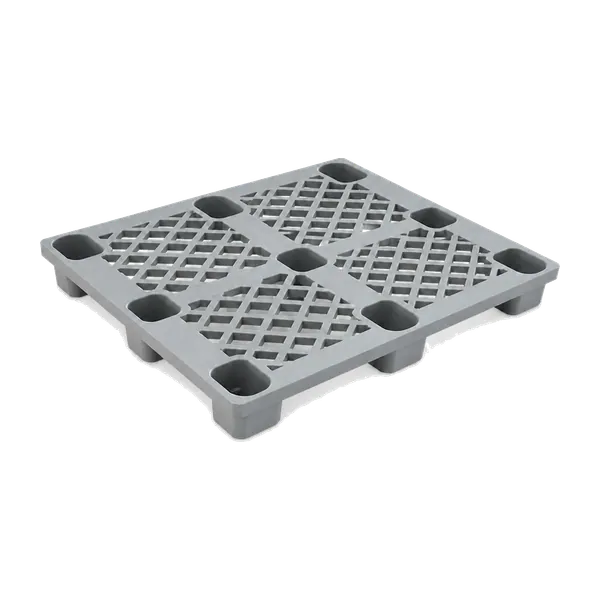
48×40 Nestable Pallet, Open Deck, 9-Leg
- Static Load (lb)
- 2,205 lb (1,000 kg)
- Bottom Type
- 9-Leg
- Size
- 47.24 × 39.37 × 5.51 in
Specifications
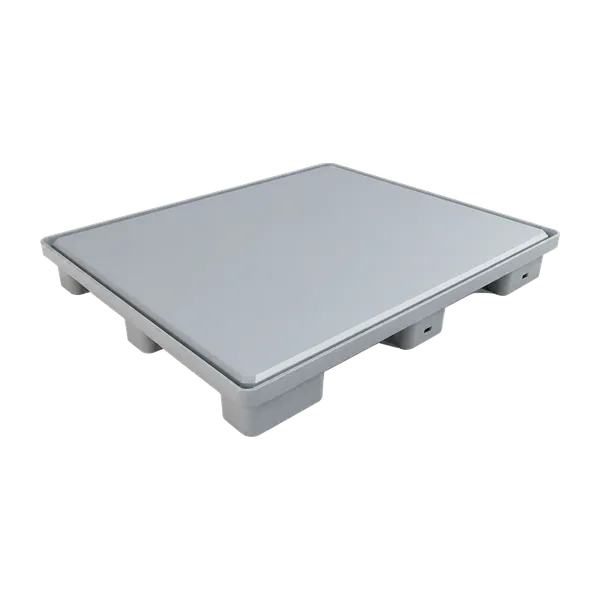
48×40 Rackable Pallet, Closed Deck, 9-Leg
- Static Load (lb)
- 11,023 lb (5,000 kg)
- Bottom Type
- 9-Leg
- Size
- 47.24 × 39.37 × 5.51 in
Specifications
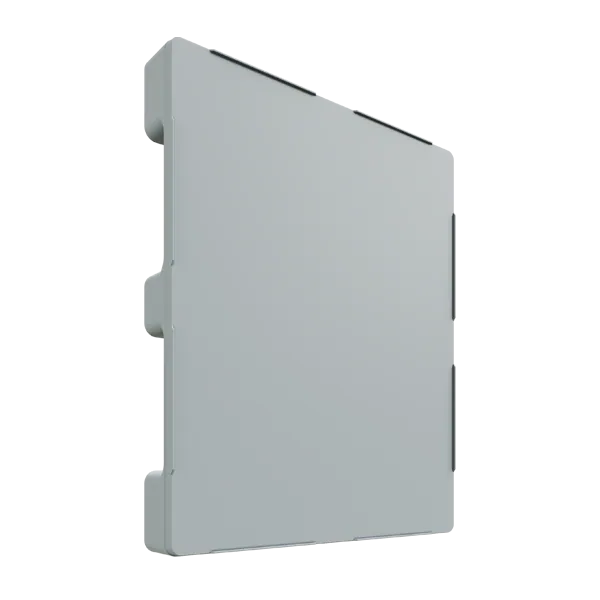
48×40 Food-Grade Pallet, Closed Deck, 9-Leg
- Static Load (lb)
- 11,023 lb (5,000 kg)
- Bottom Type
- 9-Leg
- Size
- 47.24 × 39.37 × 5.12 in
Specifications


One leg model needs a note of its own. The RP-191 sits in our rackable line and is specified as suitable for automatic shuttle racking and conveyor systems, but like the other eight its page gives no racking load. For pallets resting across beams, choose one whose page gives the figure, or ask us first.
When a skid is the better choice, and when a pallet is
Choose a platform on legs, a skid, when:
- A hand pallet jack needs to come in from any side. On the nine-leg RP-191 and FG-191 it enters from all four.
- Empties travel back to you. Nested, the NP-191 ships 1,300 to a jumbo trailer, against 650 for the rigid nine-leg RP-191.
- Weight in the hand matters. The NP-191 weighs 14.33 lb (6.5 ± 0.5 kg).

Choose a pallet, with runners or a second deck, when:
- It will sit on racking beams. Pick a model whose page publishes a racking load, such as the RP-131 at 1,323 lb (600 kg); every model in our rackable pallets line with runners gives one.
- The heaviest load in a footprint is the point. In the 48 × 40 food-grade pair, the three-runner FG-131 is rated 16,535 lb (7,500 kg) static against 11,023 lb (5,000 kg) for the nine-leg FG-191.
- A full lower face is the specification. The HD-301 is two identical grid faces welded into one part, so either face carries the load, and a worn face can be turned over and put back into service.
With runners or a second deck
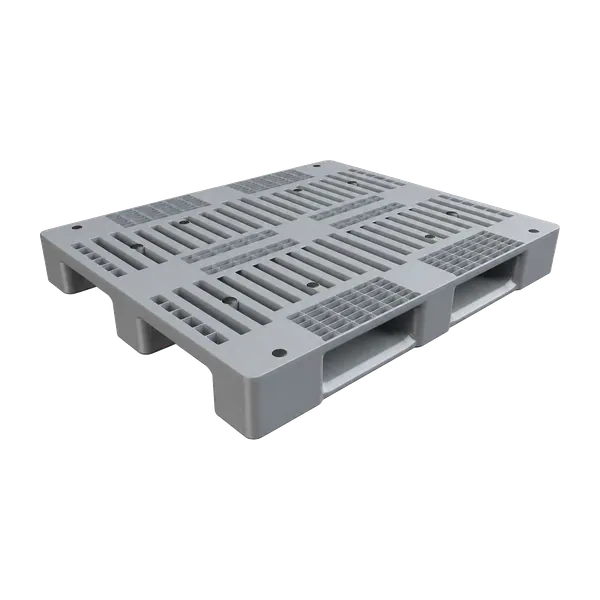
48×40 Rackable Pallet, Open Deck, 3-Runner
- Static Load (lb)
- 11,023 lb (5,000 kg)
- Bottom Type
- 3-Runner
- Size
- 47.24 × 39.37 × 5.91 in
Specifications
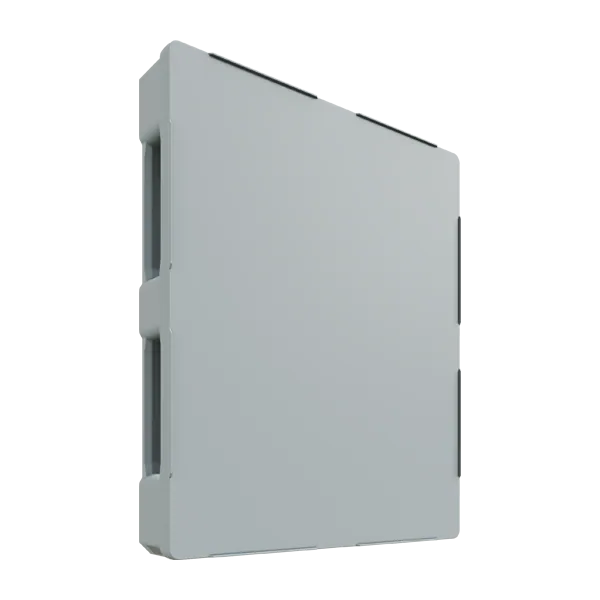
48×40 Food-Grade Pallet, Closed Deck, 3-Runner
- Static Load (lb)
- 16,535 lb (7,500 kg)
- Bottom Type
- 3-Runner
- Size
- 47.24 × 39.37 × 6.30 in
Specifications
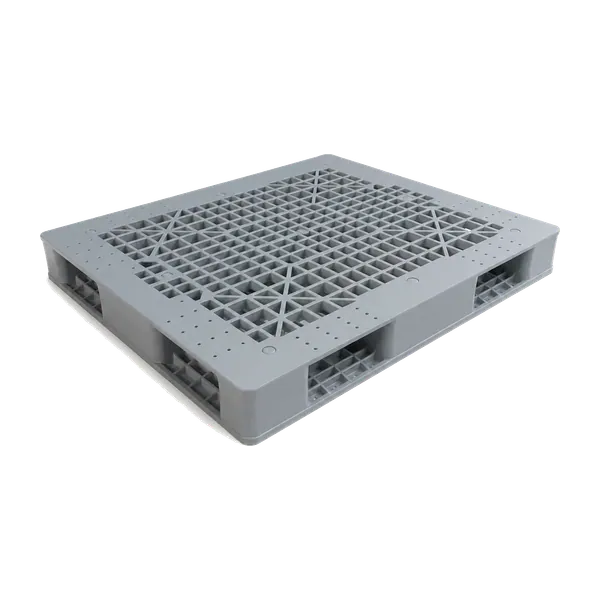
51×43 Heavy-Duty Pallet, Open Deck, Reversible
- Static Load (lb)
- 13,228 lb (6,000 kg)
- Bottom Type
- Reversible
- Size
- 51.18 × 43.31 × 5.91 in
Specifications


Skid or pallet: what to write on a quotation request
On a quotation request, the skid vs pallet question does not need settling. Either word reaches us, and we read them as the same thing. What decides the model, and the price, is what is underneath, so tell us that:
- What is under the deck: legs only, runners, or a full second face. If you are replacing wood skids, say "no bottom deck."
- The footprint, length × width with the unit, and which faces the forks go into.
- Where it will sit: on the floor, on a conveyor, across racking beams, or on top of another load.
- What lifts it: a hand pallet jack, a forklift, or an automated system.
- Whether the empties come back to you, which is where nesting earns its place.
Send those with a request for quotation and we will propose the models that fit from our plastic pallets, skid or pallet.
Common questions
- Is a skid the same as a pallet?
- In everyday use, yes: buyers search for skids and pallets of the same sizes and materials, and Canadians use the word skid far more than Americans do. Technically, no. A skid has no bottom deck and stands on its stringers, blocks or legs, while a pallet has a bottom deck under the same supports.
- What is a skid?
- A skid is a single-face pallet: a top deck fastened to stringers, blocks or legs, with nothing underneath them. The US Forest Products Laboratory noted in 1986 that the trade uses the name particularly when the platform has only two stringers.
- Why do pallets have a bottom deck?
- So that a loaded pallet can sit on top of another load. A 1939 US patent for a two-faced pallet gives that as the reason for its bottom face. A bottom deck, or runners, also adds the strength a pallet needs on racking beams, where skids are the weaker design.
- Can a skid go in pallet racking?
- Only where its published rating allows it, and skids are the weaker case: Hobbs (2024) notes their limited capacity in racking for lack of bottom deck boards. None of our nine leg models publishes a racking load, so for beam racking choose a runner or two-deck model whose page gives one.
- Do skids come in the same sizes as pallets?
- Yes. Skid dimensions are written the way pallet dimensions are, length × width × height, and the definition says nothing about size. Our leg models are on the same 1200 × 1000 mm and 1200 × 800 mm footprints as our runner pallets, plus one 800 × 600 mm display model.
- Are plastic skids covered by Canada’s wood packaging import rules?
- No. The Canadian Food Inspection Agency names skids and pallets among wood packaging products, and exempts packaging made entirely of manufactured materials, plastics included, from Canada’s import requirements for wood packaging.
- Can a pallet jack lift a skid?
- Yes. A hand pallet jack lifts a skid the way it lifts a pallet, with its forks under the deck. On our nine-leg RP-191 and FG-191 it enters from all four sides, because nothing joins the legs at the floor.
Pallet Specialist
Safoura Hasani writes the Knowledge Hub’s guides to plastic pallets: the standard sizes in Canada, the United States and Europe, how load ratings work, and choosing between rackable, nestable and hygienic designs. Every figure in her articles is checked against the product’s own page and datasheet.
