


In this article

In short
- The standard pallet in Canada and the United States is 48 × 40 in (1219 × 1016 mm), the GMA or grocery pallet: about 30% of the pallets made in the US each year.
- ISO 6780 recognises six footprints: 1200 × 800, 1200 × 1000, 1219 × 1016, 1067 × 1067, 1100 × 1100 and 1140 × 1140 mm.
- No single height is standard across pallet types: ISO 6780 sets the fork openings, not the overall height. The Euro pallet stands 144 mm (5.67 in) tall.
- A plastic “48 × 40” moulded to 1200 × 1000 mm is 19 mm shorter and 16 mm narrower than the GMA. Ours are, and the difference is worth checking against anything set to the exact inch size.
In Canada and the United States the standard pallet is 48 × 40 inches (1219 × 1016 mm), known as the GMA or grocery pallet. It is the most common of the pallet sizes made in the US, and one of the six in ISO 6780, the international standard for pallet footprints.
In this film
The other common pallet sizes are on this page: the rest of North America's top ten, the ISO and Euro sizes, how a size is written down, what pallets on the main footprints weigh, and the one thing the name "48 × 40" does not tell you about a plastic pallet. We stock plastic pallets on five of these footprints in North York, Ontario, and the last sections show which.
- Of new US pallets are 48 × 40, approximately (Clarke, 2004)
- 30%
- Footprints named in ISO 6780
- 6
- Between a 48 × 40 and a 1200 × 1000 pallet, on the length
- 19 mm
- Height of a Euro pallet, the EPAL 1
- 144 mm
What are the standard pallet sizes?
The standard pallet sizes are the six footprints in ISO 6780: 1200 × 800, 1200 × 1000, 1219 × 1016 (48 × 40 in), 1067 × 1067 (42 × 42 in), 1100 × 1100 and 1140 × 1140 mm. Regional sizes sit alongside them, such as North America's 48 × 48 and EPAL's 800 × 600 half pallet.
The chart below draws every footprint in this guide at one scale: the six ISO 6780 sizes, the ten sizes North America produced most in 2000, the footprints of the European Pallet Association's pallets, Australia's national size, and the footprints in our own catalogue. Choose a standard to see only its sizes. The dashed outline on each tile is the 48 × 40, so you can see at a glance whether a size is larger or smaller than the most common size in North America.
Every tile is drawn to the same scale. The dashed outline is the 48 × 40 in, so each size reads against the most common size in North America.
48 × 48 in
1219 × 1219 mm
#3 N. America
1300 × 1100 mm
51.18 × 43.31 in
EPAL CP4, CP7
4 in our catalogue48 × 45 in
1219 × 1143 mm
#7 N. America
1165 × 1165 mm
45.87 × 45.87 in
Australia, AS 4068 (withdrawn)
48 × 42 in
1219 × 1067 mm
#5 N. America
1140 × 1140 mm
44.88 × 44.88 in
ISO 6780EPAL CP3, CP8, CP9
44 × 44 in
1118 × 1118 mm
#8 N. America
48 × 40 in
1219 × 1016 mm
ISO 6780#1 N. America, as 48 × 40#3 N. America, as 40 × 48
1100 × 1100 mm
43.31 × 43.31 in
ISO 6780
1 in our catalogue1200 × 1000 mm
47.24 × 39.37 in
ISO 6780EPAL 2, 3, CP1, CP6
13 in our catalogue42 × 42 in
1067 × 1067 mm
ISO 6780#2 N. America
48 × 36 in
1219 × 914 mm
#10 N. America
40 × 40 in
1016 × 1016 mm
#5 N. America
1200 × 800 mm
47.24 × 31.50 in
ISO 6780EPAL 1 (Euro pallet), CP2
10 in our catalogue1140 × 760 mm
44.88 × 29.92 in
EPAL CP5
36 × 36 in
914 × 914 mm
#9 N. America
800 × 600 mm
31.50 × 23.62 in
EPAL 6 (half pallet), 7
1 in our catalogue
Inch sizes are written in inches first, as the North American trade names them, and metric sizes in millimetres first. The regions are the ones Clarke (2004) gives for the six ISO sizes.
| Size | Converted | Named by | Most used in, per Clarke |
|---|---|---|---|
| 48 × 40 in, the GMA | 1219 × 1016 mm | ISO 6780 | North America |
| 42 × 42 in | 1067 × 1067 mm | ISO 6780 | North America, Europe, Asia |
| 1200 × 1000 mm | 47.24 × 39.37 in | ISO 6780; EPAL 2, EPAL 3, CP1, CP6 | Europe, Asia |
| 1200 × 800 mm, the Euro pallet | 47.24 × 31.50 in | ISO 6780; EPAL 1, CP2 | Europe |
| 1100 × 1100 mm | 43.31 × 43.31 in | ISO 6780; AS 4068 (for ISO freight containers) | Asia |
| 1140 × 1140 mm | 44.88 × 44.88 in | ISO 6780; EPAL CP3, CP8, CP9 | Australia |
| 1165 × 1165 mm | 45.87 × 45.87 in | AS 4068 (Australia, withdrawn) | Not an ISO size |
| 1300 × 1100 mm | 51.18 × 43.31 in | EPAL CP4, CP7 | Not an ISO size |
| 1140 × 760 mm | 44.88 × 29.92 in | EPAL CP5 | Not an ISO size |
| 800 × 600 mm, the half pallet | 31.50 × 23.62 in | EPAL 6, EPAL 7 | Not an ISO size |
The other North American sizes, from 48 × 48 down to 36 × 36, are in the next section with the industries that use them.
Which pallet sizes are most common in North America?
The most-produced sizes in North America were ranked from Southern Illinois University's survey of the US wood pallet industry for 2000, and John Clarke reproduced the list in Pallets 101 (2004), a paper Penn State's Department of Agricultural and Biological Engineering listed among its wood packaging publications, also reprinted by Pallet Enterprise. Those figures are from 2000, so read them as the shape of the market rather than this year's numbers.
| Rank | Size, in | Size, mm | Typical industries |
|---|---|---|---|
| 1 | 48 × 40 | 1219 × 1016 | Grocery, common in many other industries |
| 2 | 42 × 42 | 1067 × 1067 | Telecommunications, paint |
| 3 | 48 × 48 | 1219 × 1219 | Drums |
| 3 | 40 × 48 | 1016 × 1219 | US Department of Defense, cement |
| 5 | 48 × 42 | 1219 × 1067 | Chemical, beverage |
| 5 | 40 × 40 | 1016 × 1016 | Dairy |
| 7 | 48 × 45 | 1219 × 1143 | Automotive |
| 8 | 44 × 44 | 1118 × 1118 | Drums, chemical |
| 9 | 36 × 36 | 914 × 914 | Beverage |
| 10 | 48 × 36 | 1219 × 914 | Beverage, shingles, packaged paper |
Clarke puts the 48 × 40 at about 30% of the pallets produced in the US each year, and the ten sizes together at about 60%. The tenth is under 2% of the market on its own, and the remaining 40% is, in his words, "hundreds of sizes, typically tailored to specific customers."
Of every ten new pallets made in the US
- 3 · 48 × 40 in, the GMA palletAbout 30% of production
- 3 · The other nine top-ten sizes42 × 42 to 48 × 36, about 30% together
- 4 · Hundreds of sizes made to orderAbout 40%
Two things in the table are easy to read past. The 48 × 40 and the 40 × 48 cover exactly the same floor and are ranked as two different pallets, which is explained under how a pallet size is written. And the ranking comes from a survey of wood pallet makers; Clarke estimated that wood was 90 to 95% of the US market at the time, so it covers nearly all of it.
What is the standard pallet size in Canada?
The standard pallet size in Canada is 48 × 40 inches (1219 × 1016 mm), the same GMA footprint used in the United States, and the size Canada's grocery trade pooled through the Canadian Pallet Council from 1977 to 2015.
The grocery trade ran a shared pool of these pallets for almost forty years. As Inside Logistics reported, the Canadian Pallet Council was formed in 1977 by the Grocery Retailers Association and the Grocery Manufacturing Association, originally as the GPMC Pallet (Grocery Product Manufacturers of Canada), "to manage the increasing use of the 48- by 40-inch four-way entry wooden pallet." Eight years before it closed it had over seven million pallets in circulation. The members voted to close the council in March 2015, after losing the support of all the major distributors, and its operations were to end by May 2015.
The pool is gone; the size is not. 1219 × 1016 mm is how ISO 6780 writes the 48 × 40, and Clarke lists North America as where it is used. This guide treats it as the standard on both sides of the border. Metric sizes come into it when the pallet itself is metric, as ours are. That is the subject of the section on 1200 × 1000.
ISO 6780: the six sizes the world agreed on
ISO 6780 exists, in its own words, "to promote distribution efficiency through the use of a limited number of internationally recognized and approved pallet sizes that most countries can adopt." The 2003 edition names six pallet sizes, in two tables:
- Rectangular (Table 1): 1200 × 800, 1200 × 1000 and 1219 × 1016 mm.
- Square (Table 2): 1067 × 1067, 1100 × 1100 and 1140 × 1140 mm.
Three details in the standard matter when you are checking a pallet against it:
- Tolerance. A pallet may be up to 3 mm larger or 6 mm smaller than its nominal plan size (clause 4.1.3). On a 1219 mm side, that is anything from 1213 to 1222 mm.
- Plastic is measured at room temperature. For plastics, the standard says dimensions should be measured at 23 °C ± 2 °C.
- Length runs with the stringers. Pallet length is the deck dimension in the direction of the stringers or stringerboards, and it is written first. More on that below.
What size is a Euro pallet, and a half pallet?
A Euro pallet, the EPAL 1, is 800 × 1200 × 144 mm (31.50 × 47.24 × 5.67 in), weighs approximately 25 kg and has a safe working load of 1,500 kg. The EPAL 6 half pallet is 800 × 600 × 144 mm, half the Euro footprint.
The European Pallet Association (EPAL) publishes the key specification of each of its pallets. Four are covered here:
| Pallet | Length × width × height | Weight, approx. | Safe working load |
|---|---|---|---|
| EPAL 1, the Euro pallet | 800 × 1200 × 144 mm 31.50 × 47.24 × 5.67 in | 25 kg (55 lb) | 1,500 kg (3,307 lb) |
| EPAL 2 | 1200 × 1000 × 162 mm 47.24 × 39.37 × 6.38 in | 35 kg (77 lb) | 1,250 kg (2,756 lb) |
| EPAL 3 | 1000 × 1200 × 144 mm 39.37 × 47.24 × 5.67 in | 30 kg (66 lb) | 1,500 kg (3,307 lb) |
| EPAL 6, the half pallet | 800 × 600 × 144 mm 31.50 × 23.62 × 5.67 in | 9.5 kg (21 lb) | 750 kg (1,653 lb) |
EPAL also gives a limit for stacking loaded pallets on a solid, even floor: the bottom pallet may carry up to 5,500 kg for an EPAL 1, 4,250 kg for an EPAL 2, 4,500 kg for an EPAL 3 and 1,500 kg for an EPAL 6. Beyond these four, EPAL makes an EPAL 7 half pallet on the same 800 × 600 footprint, 163 mm tall, and nine CP pallets, CP1 to CP9, on five footprints; they are in the chart above.
Notice that EPAL 2 and EPAL 3 share a footprint and are still two pallets, with different heights, weights and loads. EPAL also writes the Euro pallet 800 × 1200, length first, where plastic pallet catalogues usually write 1200 × 800, ours included. Both are correct, and the next section explains why.
In our catalogue, the Euro pallets are on the 1200 × 800 footprint, and the NP-461 display pallet, at 31.50 × 23.62 × 5.31 in (800 × 600 × 135 mm), is on the half-pallet footprint.
How a pallet size is written
ISO 6780 defines pallet length as the deck dimension in the direction of the stringers or stringerboards, and says length is written first. Clarke sets out the trade's conventions, which agree with it for wood:
- Wood stringer pallets are named stringer length first, then deck board length. The GMA has 48 in stringers, so it is a 48 × 40, not a 40 × 48.
- Block pallets are named by the top stringerboard first, which is why the Euro pallet is formally 800 × 1200.
- Non-wood pallets, plastic included, are usually listed longer side first. That is the convention our catalogue uses.
The name is the same whatever is under the deck. A stringer pallet with no bottom deckboards, standing on its stringers alone, is the platform the trade calls a skid, and our guide to skid vs pallet sets out where that line falls and why it matters in racking.
The reason it matters is the forks. On a stringer pallet without notches, forklifts and pallet jacks can only go in between the stringers, from the two ends, and ISO 6780 defines the ends as the faces on the width. A 48 × 40 and a 40 × 48 take up the same floor but are entered from different faces:
48 × 40
Stringers 48 in long. Forks and pallet jacks enter the two 40 in ends.
40 × 48
Stringers 40 in long, so its ends are the 48 in faces. Forks and pallet jacks enter there.
Stringer Deck board Fork entry, stringers unnotched
When you order, write the size as length × width × height with the unit, and say which faces the forks need to enter. Notched stringers let a forklift in from the sides as well, though not a pallet jack, which is why Clarke calls that design partial four-way.

Is there a standard pallet height?
No single pallet height is standard. ISO 6780 sets the openings that forks and pallet trucks need, not the overall height, so the height comes from the design: a Euro pallet stands 144 mm, and the plastic pallets in our catalogue stand 130 to 170 mm.
ISO 6780 fixes the plan dimensions, then the openings the forks need, and leaves the overall height to the design:
- Pallet trucks: at least 100 mm of clear opening under the top deck on a high-profile pallet, 95 mm on a standard one and 89 mm on a low one, and the top of that opening no more than 156 mm above the bottom of the pallet.
- Forklift trucks: at least 50 mm of vertical clearance for the forks.
Specifications such as EPAL's do fix a height for each pallet: 144 mm (5.67 in) for the EPAL 1, 3 and 6, and 162 mm (6.38 in) for the EPAL 2. The plastic pallets in our catalogue run from 130 mm, the FG-191 and FG-291 nine-leg food-grade pallets, to 170 mm, the EP-232 grid-deck Euro pallet at 47.24 × 31.50 × 6.69 in (1200 × 800 × 170 mm). Each product page gives the exact height.
48 × 40 and 1200 × 1000 are not the same size
A 1200 × 1000 mm pallet is not a 48 × 40. It measures 47.24 × 39.37 in, 19 mm shorter and 16 mm narrower than the 1219 × 1016 mm GMA, and ISO 6780 lists the two as separate sizes.
This is the detail the name hides. A plastic pallet sold as a "48 × 40" is not always 48 × 40 inches, because it may be moulded to the metric 1200 × 1000 mm footprint. Ours are: the 48×40 in our product names is trade shorthand, and the size on each product page reads, for example, 47.24 × 39.37 × 5.91 in (1200 × 1000 × 150 mm) for the RP-131 rackable pallet.
Our 1200 × 1000 mm pallets, sold as 48×40
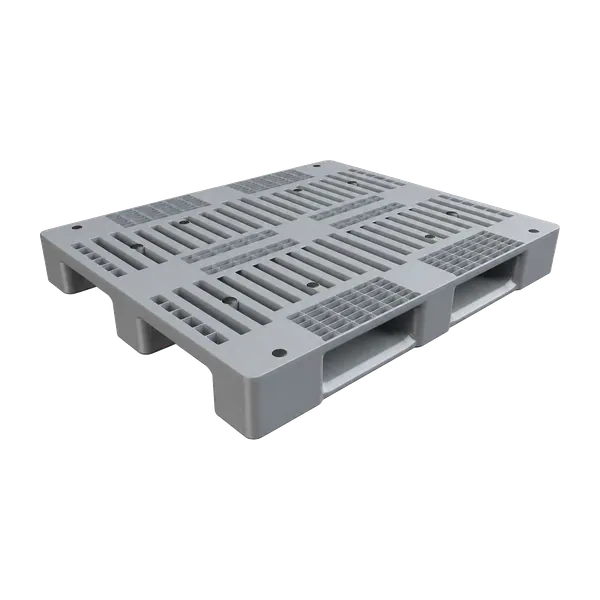
48×40 Rackable Pallet, Open Deck, 3-Runner
- Static Load (lb)
- 11,023 lb (5,000 kg)
- Bottom Type
- 3-Runner
- Size
- 47.24 × 39.37 × 5.91 in
Specifications
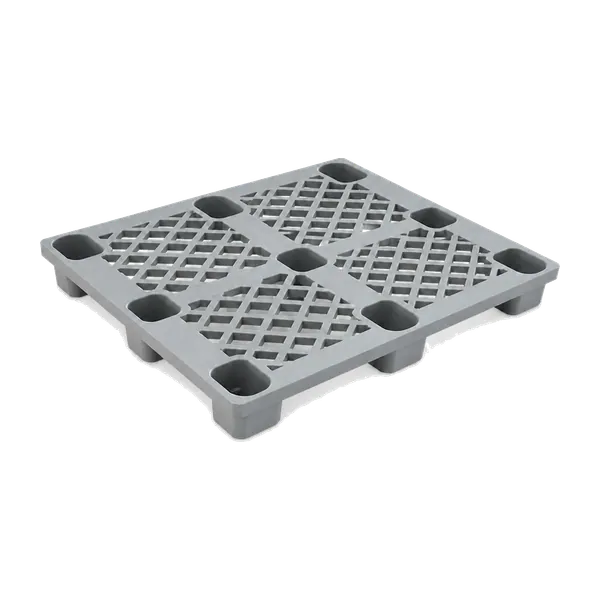
48×40 Nestable Pallet, Open Deck, 9-Leg
- Static Load (lb)
- 2,205 lb (1,000 kg)
- Bottom Type
- 9-Leg
- Size
- 47.24 × 39.37 × 5.51 in
Specifications
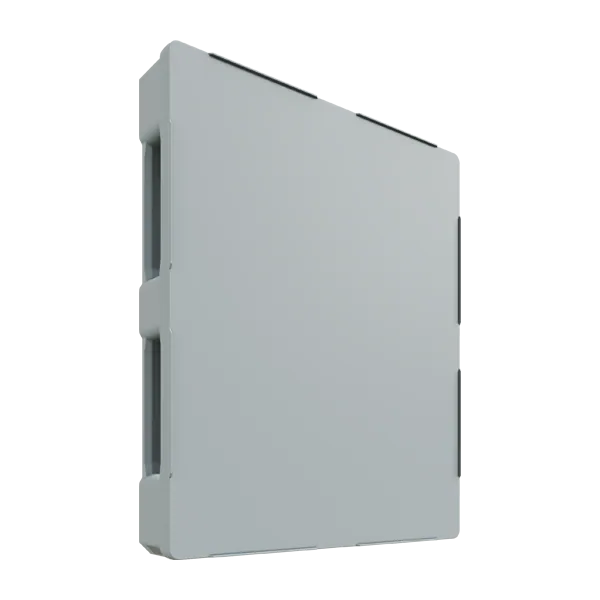
48×40 Food-Grade Pallet, Closed Deck, 3-Runner
- Static Load (lb)
- 16,535 lb (7,500 kg)
- Bottom Type
- 3-Runner
- Size
- 47.24 × 39.37 × 6.30 in
Specifications


Both sizes are in ISO 6780's Table 1, and they are 19 mm apart on the length and 16 mm apart on the width:
Whole, at one scale. The box marks the corner opposite the one they share.
- Dashed:
- 48 × 40 in, 1219 × 1016 mm
- Solid:
- 1200 × 1000 mm, 47.24 × 39.37 in
The standard's own tolerance keeps them apart. At most 3 mm over, a 1200 mm side is at most 1203 mm; at most 6 mm under, a 1219 mm side is at least 1213 mm. Two pallets made within that tolerance can never measure the same.
The metric footprint has backers of its own. Clarke records that in 2002 the computer industry's EIPS pallet task group recommended 1200 × 1000 mm as its primary global footprint, for its metric dimensions, its recognition in ISO, its ability to fill most transport vehicles efficiently and its similarity in size to the 48 × 40.
Whether 19 mm matters depends on what the pallet meets. Where something in your operation is built to the exact 1219 × 1016 mm envelope, such as conveyor guides, an automated store, or a stretch-wrapper or labeller set to the inch size, tell us when you ask for a price and we will confirm the controlling dimension in writing before you order.

What a pallet of each size weighs
A pallet's weight follows its design more than its footprint. On EPAL's figures, a wood Euro pallet weighs approximately 25 kg and a wood EPAL 2 on the 1200 × 1000 footprint approximately 35 kg. Plastic pallets on the same footprints in our catalogue:
| Footprint | Lightest in our catalogue | Heaviest in our catalogue |
|---|---|---|
| 1200 × 800 mm | NP-291, 13.23 lb (6 ± 0.5 kg) | FG-231, 39.68 lb (18 ± 0.5 kg) |
| 1200 × 1000 mm | NP-191, 14.33 lb (6.5 ± 0.5 kg) | FG-131, 48.50 lb (22 ± 0.5 kg) |
| 800 × 600 mm | NP-461, 6.39 lb (2.9 ± 0.5 kg) | The only model on this footprint |
On one footprint the lightest is about a third of the heaviest: the NP-291 nine-leg nestable weighs a third of the FG-231 closed-deck food-grade pallet, and the NP-191 under a third of the FG-131. Choose the size for the building and the vehicle, then the design for the load. How plastic and wood compare on lumber and on carbon is set out with sources on our sustainability page.
Our pallet sizes, by footprint
Our plastic pallets come on five footprints. The link on each opens the whole range on that footprint, across every line:
| Footprint | Nominal size in | Lines on it |
|---|---|---|
| 1200 × 1000 mm 47.24 × 39.37 in | ISO 6780; EPAL 2, 3, CP1, CP6 | Rackable, nestable, food-grade |
| 1200 × 800 mm 47.24 × 31.50 in | ISO 6780; EPAL 1, CP2 | Euro, nestable, food-grade |
| 1100 × 1100 mm 43.31 × 43.31 in | ISO 6780; not an EPAL size | Rackable |
| 1300 × 1100 mm 51.18 × 43.31 in | EPAL CP4, CP7; not an ISO size | Heavy-duty |
| 800 × 600 mm 31.50 × 23.62 in | EPAL 6, EPAL 7 | Nestable display pallet |
In our product names the trade shorthand is 48×40 for 1200 × 1000, 47×31 for 1200 × 800, 43×43 for 1100 × 1100, 51×43 for 1300 × 1100 and 31×24 for 800 × 600. The size on every product page gives both units exactly.
On the other four footprints
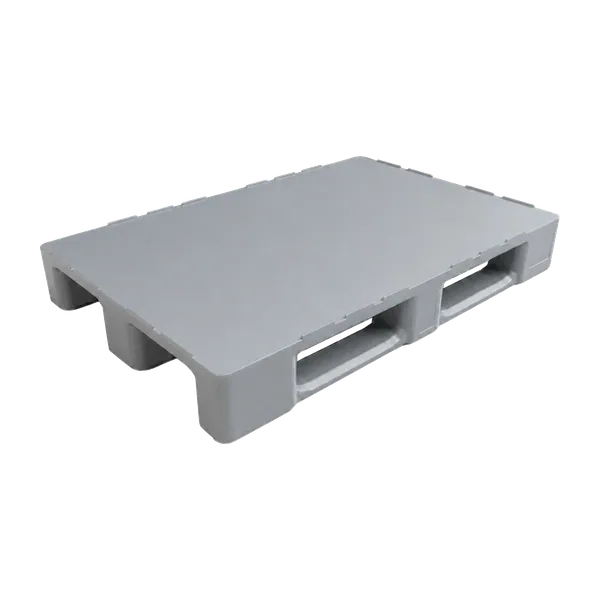
47×31 Euro Pallet, Closed Deck, 3-Runner
- Static Load (lb)
- 11,023 lb (5,000 kg)
- Bottom Type
- 3-Runner
- Size
- 47.24 × 31.50 × 6.10 in
Specifications
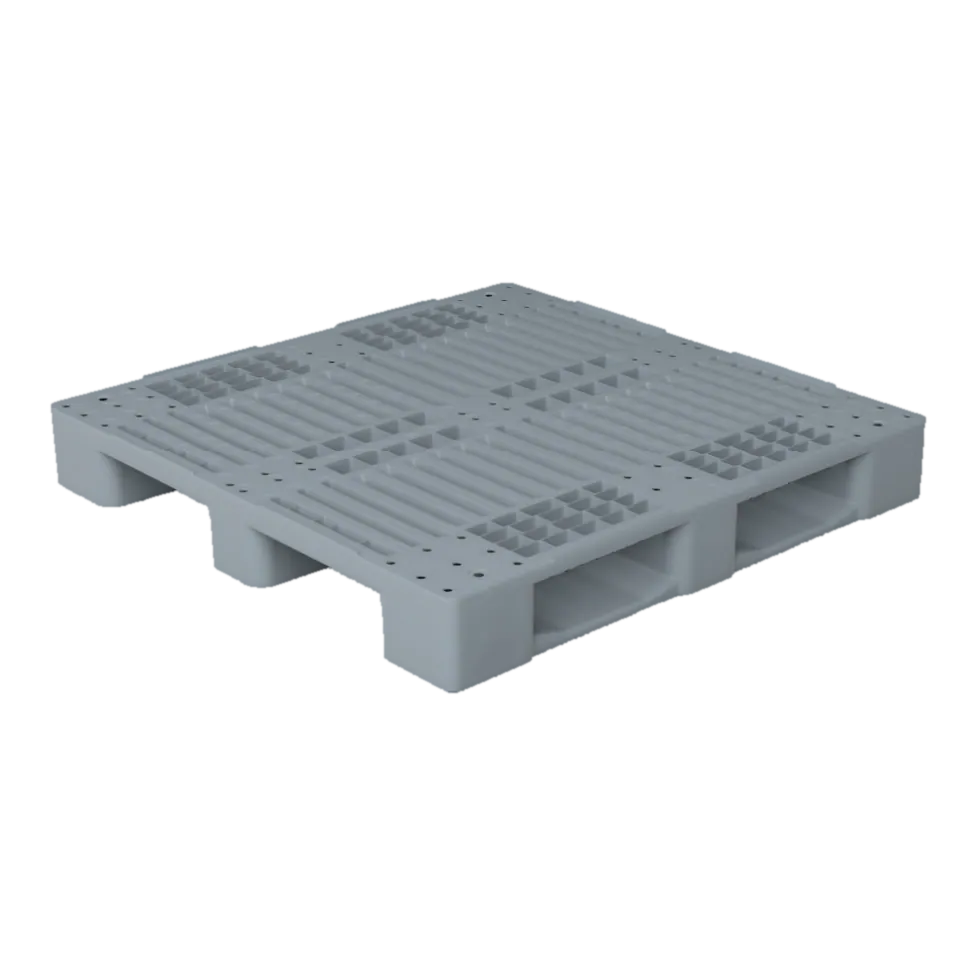
43×43 Rackable Pallet, Open Deck, 3-Runner
- Static Load (lb)
- 11,023 lb (5,000 kg)
- Bottom Type
- 3-Runner
- Size
- 43.31 × 43.31 × 5.91 in
Specifications
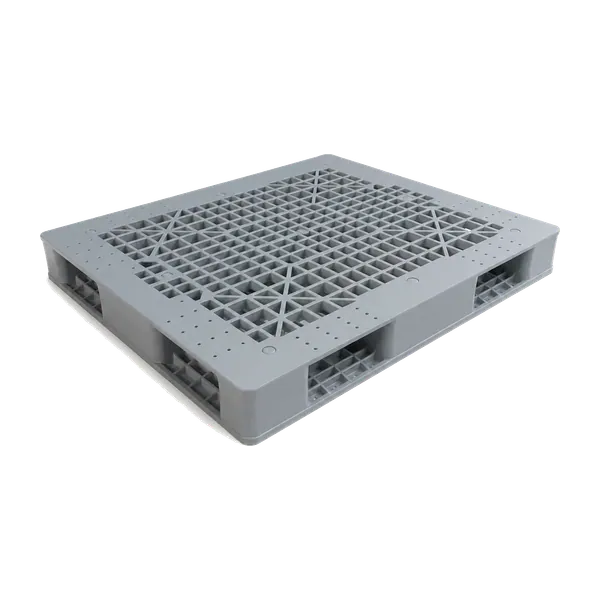
51×43 Heavy-Duty Pallet, Open Deck, Reversible
- Static Load (lb)
- 13,228 lb (6,000 kg)
- Bottom Type
- Reversible
- Size
- 51.18 × 43.31 × 5.91 in
Specifications
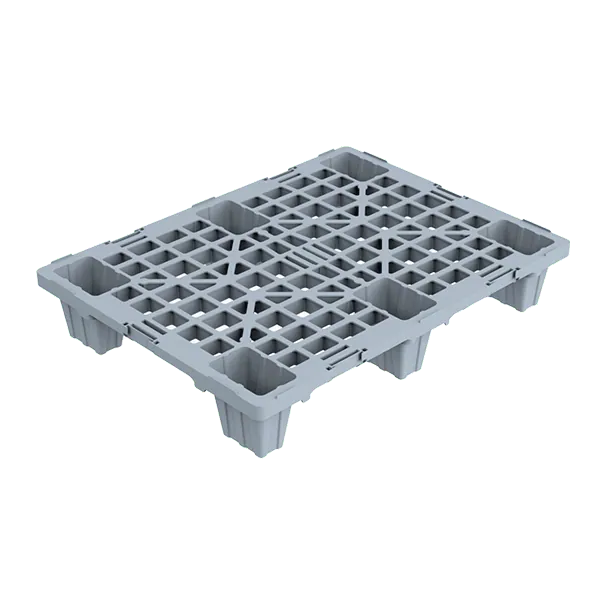
31×24 Nestable Display Pallet, 6-Leg
- Static Load (lb)
- 1,764 lb (800 kg)
- Bottom Type
- 6-Leg
- Size
- 31.50 × 23.62 × 5.31 in
Specifications


What to send us for a price
A quotation is only as exact as the size it is based on. These five things are what we need to quote a pallet:
- The footprint, length × width with the unit, and which faces the forks go into.
- Any height limit: a conveyor, a pallet-truck opening, a trailer with a full load.
- The load and where it sits: on the floor, moving on forks, or in racking. Static, dynamic and racking loads are separate ratings. For racking, choose a model whose page publishes a racking load; that figure is what decides a rackable pallet.
- What handles it: pallet truck, forklift or an automated system.
- Whether the empties travel back. Nestable pallets stack one inside another when empty, and each product page gives how many fit on a trailer.
Send those with a request for quotation and we will price the pallet that fits, in the size your operation actually runs on.
Common questions
- What is the most common pallet size in North America?
- The 48 × 40 in (1219 × 1016 mm) GMA or grocery pallet. Clarke (2004) puts it at about 30% of the pallets produced in the US each year, and it is also one of the six ISO 6780 sizes.
- What size is a Euro pallet?
- EPAL gives the Euro pallet as 800 × 1200 × 144 mm (31.50 × 47.24 × 5.67 in), approximately 25 kg, with a safe working load of 1,500 kg. Its footprint is the 1200 × 800 mm ISO 6780 size.
- What are half pallet dimensions?
- The EPAL 6 half pallet is 800 × 600 × 144 mm (31.50 × 23.62 × 5.67 in), approximately 9.5 kg, with a safe working load of 750 kg. It is half a Euro pallet: two of them cover one 1200 × 800 footprint.
- Is a 1200 × 1000 mm pallet the same as a 48 × 40?
- No. 1200 × 1000 mm is 47.24 × 39.37 in, 19 mm shorter and 16 mm narrower than 1219 × 1016 mm. ISO 6780 lists them as two separate sizes, and within its manufacturing tolerance of +3 mm and −6 mm one can never pass for the other.
- What is the standard pallet height?
- No single height is standard. ISO 6780 sets the plan size and the fork openings, not the overall height. The EPAL 1, 3 and 6 stand 144 mm and the EPAL 2 162 mm, and the plastic pallets in our catalogue run from 130 to 170 mm.
- Are 48 × 40 and 40 × 48 pallets the same?
- They cover the same floor, but a wood stringer pallet is named by its stringer length first, so a 40 × 48 has 40 in stringers, and its ends, where forks enter when the stringers are not notched, are its 48 in faces. Clarke (2004) ranks them separately: 48 × 40 first, 40 × 48 third, used by the US Department of Defense and the cement trade.
Pallet Specialist
Safoura Hasani writes the Knowledge Hub’s guides to plastic pallets: the standard sizes in Canada, the United States and Europe, how load ratings work, and choosing between rackable, nestable and hygienic designs. Every figure in her articles is checked against the product’s own page and datasheet.
